

Restored volume, rebuilt system
On Day 213 the Hormuz crisis is no longer a supply outage. It is a rebuilt export system. Gulf crude excluding Iran is back at pre-war volumes, but it moves through pipelines, a shuttle fleet, offshore transfers and a US-protected corridor rather than through an open strait.¹˒²
The distinction matters. The volume shock has ended; the cost, product and security shocks have not. The system has proved adaptive, yet every barrel now carries a freight, insurance and escort premium.
In GSR terms, the allocation progression has reached its final stage: bloc logistics under military protection. The diplomatic track, meanwhile, is negotiating only the sequencing of a reopening. Five signals from the last two days define the operating picture.
Signal 1. Volume restored, route rebuilt: the cost stack is the new chokepoint
The export recovery is real and now conclusive. Kpler, reconstructing dark transits, ship-to-ship transfers and satellite-confirmed loadings, counts at least 16.5 mbd of crude leaving the Gulf between 1 and 28 September. That matches the pre-war average excluding Iran; including Iran, still under US blockade, it is 91%.²
JPMorgan’s 29 September note puts the 10-day average of Middle East crude exports at 17.5 mbd, 98% of pre-war, and crude plus products at 89% of 2025 levels, 11% short.³ Saudi Arabia has restored the East-West pipeline to at least 3.5 mbd, about half its capacity, and all seven Yanbu berths were occupied again by 27 September.²˒³
The shortfall now sits in products, not crude. Middle East product exports run at about 3 mbd, 58% of pre-war.³ Through the strait itself, crude transits have matched the pre-war baseline of 13.5 mbd, while products run at 677,000 bpd against 3.6 mbd before the war.⁴
The system has proved adaptive, not fragile. It absorbed three shocks: the Houthi squeeze on the Red Sea, the lapse of the US–Iran MoU and the 10 September strike on the East-West pipeline, rerouting within days each time.² The architecture has changed: 40% of Gulf crude now exits without crossing Hormuz, against 17% before the war, and in August over 70% of crude crossing the strait changed tankers off Fujairah or Sohar.²
Where the cost now sits: day rates and insurance
The shuttle model turns a volume problem into a tonnage problem. At least 63 VLCCs work the Gulf shuttle trade, with a core fleet completing round trips about every 16 days.² Moving the same Saudi volume took 24 VLCCs in August and needs about 40 in September because of ship-to-ship transfers.⁷
Day rates show it. VLCC earnings on the benchmark Gulf–China run hit a record $1.27 million a day on 21 September, per LSEG data.⁷ The Baltic TD3C assessment first crossed $1 million on 14 September, up from about $700,000 at the start of the month. Owners loading just outside the strait earned about $450,000 a day, and the premium spills into the Atlantic: about $380,000 a day on West Africa–Far East.⁷
War-risk cover is the second layer. The last published broker quote, from Marsh on 22 July, put additional war-risk premiums for Hormuz at 7.5% to 10% of hull value, against about 0.25% before the war; at peak that meant about $21 million per transit for a 270,000-tonne tanker.⁷ We found no fresh public quote for late September. The strikes on 29 September give underwriters no reason to cut.⁵
The GSR reading: the chokepoint has moved from geography to the cost stack. Barrels flow, but each carries a freight and insurance surcharge, a dependency on escort and transfer capacity, and a products shortfall behind it. Kpler names the binding constraints ahead: Iran’s 1.7 mbd, Petroline repairs of four to six weeks, and record ship-to-ship congestion in the Gulf of Oman.² Front-month Brent at $97.46 on 30 September prices the volume recovery, not the products gap.⁶
Signal 2. The blockade asymmetry: Iran’s leverage shifts from the strait to infrastructure
Tehran confirmed today that it has received the US counterproposal; Qatari mediators briefed Foreign Minister Araghchi in Doha on Tuesday.¹ Iran’s plan trades a reopening within seven days for the lifting of the US blockade of Iranian ports, plus oil sanctions relief and the release of frozen assets.¹ The US terms are not public, and the two sides disagree sharply on sequencing.¹
The pivot is an asymmetry. Gulf producers now export at or near pre-war volumes, while Iranian crossings have stayed near zero since the blockade was reimposed in July.² Iran has lost control over volume. Its remaining lever is damage.
Tehran is saying so openly. Parliament Speaker Ghalibaf warned that no infrastructure in the region would be safe without guarantees for Iran’s security, and that if Iran cannot sell oil, neither will its neighbours.⁵ Washington reads the same export data as proof of control and has less reason to concede. Tehran, meanwhile, presents the US drawdown from Iraq as a win for its axis, and unconfirmed reports say Trump may weigh renewed escalation only after the midterms.¹
The GSR implication: as Iran’s shipping leverage falls, the probability of a strike on Gulf energy infrastructure rises. For price, that is now the variable to watch, not transit counts.
Signal 3. DragonBear capability below the attribution threshold
US intelligence assessments now credit Chinese groups with satellite imagery and intelligence that improved Iranian targeting of ships and US bases. Chinese and Russian technical help on missile and drone guidance sits on top of that.⁸ Washington’s response has been summitry, not penalty: Trump warned Xi during their 24 September meeting, and the US ambassador described the support as indirect, without direct evidence.⁹
This is the Triumvirate of Happiness at work. The US manages confrontation with Beijing rather than escalating it, while the DragonBear supplies Iran with capability deniable enough to stay below the threshold of punishment.
The entanglement runs both ways. This week the US also sanctioned Russian companies tied to Iranian weapons procurement, the same networks that link the Hormuz and Ukraine theatres.¹⁰
Beijing’s position is dual. It enables Iranian leverage and is also the largest victim of its use, as the marginal buyer of Gulf crude. That tension is the most credible external pressure on Tehran to settle.
Signal 4. The European front moves from grey zone to nuclear doctrine
Russia has sent NATO a formal diplomatic note: it would use its entire arsenal, including nuclear weapons, if the Alliance tried to isolate Kaliningrad. NATO rejected the claim that its exercises threaten Russian territory.¹¹ The note followed a public nuclear warning from the Russian embassy in London on 29 September. That warning came after Paris agreed to talks on Latvia joining France’s nuclear umbrella.¹²
In Ukraine, the aerial campaign against the grid has escalated since the end of August. Strikes on 30 September killed seven people as Kyiv braces for winter.¹³ In parallel, Putin’s envoy Kirill Dmitriev held what a US official called constructive talks in Washington, including on post-war US–Russia energy projects.¹⁴
The pivot is a bifurcation of threat perception inside the West. Europe is receiving explicit nuclear signalling on the Baltic while Washington discusses post-war energy business with Moscow. The hybrid war between European NATO and Russia is being escalated in the one arena where the US is least engaged.
Signal 5. Resilience depletion: the LNG gap, Europe’s storage deficit and the sulphur turn
Gas is the one flow the rebuilt Gulf system does not carry. Crude found pipelines and shuttles; LNG found neither, because Qatar has no bypass route and transferring LNG between ships is technically harder. Only 13 QatarEnergy carriers crossed Hormuz in September, several running dark.¹⁵
QatarEnergy has extended force majeure to Asian buyers through November, and Edison’s Italian deliveries stay suspended until early December.¹⁵ Even a full reopening leaves 12.8 mtpa at Ras Laffan, about 17% of exports, out for up to five years.¹⁵
Europe enters the heating season without a buffer. EU storage stood just below 71% on 27 September, against more than 80% in each of the past five years; German sites were about 57% full.¹⁶
The fertiliser leg of the cascade has rotated. Nitrogen has normalised, with urea back to January levels by late August after Chinese quota releases. Sulphur is now the bottleneck: prices have more than doubled since January, and elemental sulphur exports fell 33% in the first half of 2026 amid export controls in three producing countries.¹⁷
This activates the second GSR cascade chain: sulphur to sulphuric acid to HPAL nickel, SX-EW copper and phosphate. Neither sulphur nor fertiliser has strategic stockpiles, so the cascade moves straight from price to allocation.
GSR Watch Indicators: status on 30 September
Eight of the ten indicators are assessed; more indicators, including desalination and critical infrastructure strikes, are not covered in this brief.
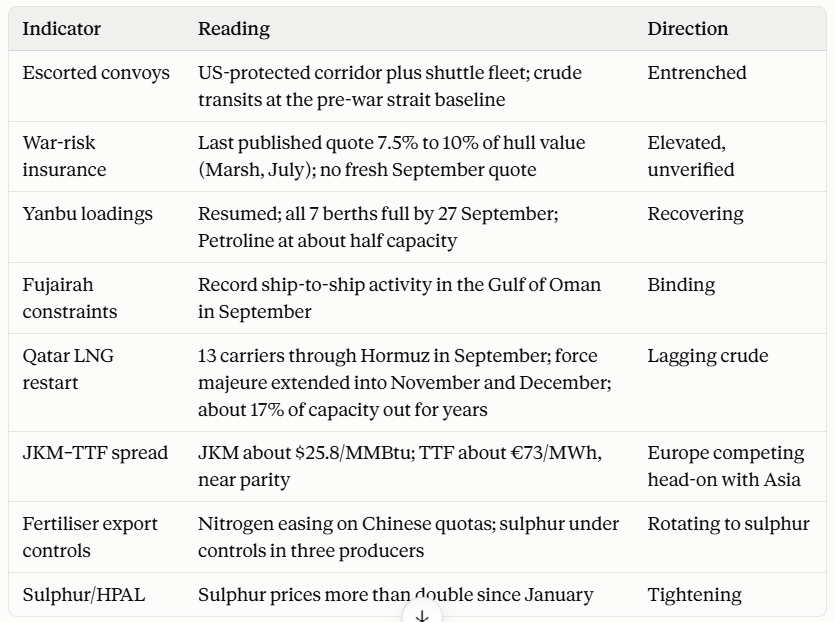
The bottom line
The volume war is over; the cost war is not. Gulf crude has returned by rebuilding the export system around the strait, and that system has absorbed three shocks. The risk has migrated to freight, insurance, products, LNG, and to Iran’s one remaining lever: strikes on infrastructure.
Europe carries the compound exposure. It enters winter with a gas deficit, a products shortfall, a sulphur squeeze and a Russian nuclear signal on the Baltic, while Washington’s attention and its bargaining with Moscow and Beijing run elsewhere. The risk to price is simultaneity, not any single shock.
Notes
CBS News, “Live Updates: Iran Says It Has Received U.S. Counterproposal to 7-Day Ceasefire Plan Rejected by Trump,” CBS News, September 30, 2026, https://www.cbsnews.com/live-updates/iran-war-us-negotiations-strait-of-hormuz-oil/; “Iran Says It Got US Response on Ceasefire Proposal as Washington Exits Iraq,” Business Standard (Reuters), September 30, 2026, https://www.business-standard.com/amp/world-news/iran-says-it-got-us-response-on-ceasefire-proposal-as-washington-exits-iraq-126093000961_1.html; “Iran Says It Has Received US Response to Ceasefire Proposal,” Sweden Herald, September 30, 2026, https://swedenherald.com/article/iran-says-it-has-received-us-response-to-ceasefire-proposal.
Emmanuel Belostrino, “Explainer: How Mideast Gulf Crude Exports Returned to Pre-War Levels,” Kpler, September 30, 2026, https://www.kpler.com/blog/explainer-how-mideast-gulf-crude-exports-returned-to-pre-war-levels.
“JPMorgan and Goldman See Mideast Oil Flows Near Pre-War Levels,” Bloomberg via Energy Connects, September 30, 2026, https://www.energyconnects.com/news/oil/2026/september/jpmorgan-and-goldman-see-mideast-oil-flows-near-pre-war-levels/; “Oil Holds Decline as Middle East Exports Seen Near Pre-War Level,” Bloomberg via Energy Connects, September 30, 2026, https://www.energyconnects.com/news/oil/2026/september/oil-holds-decline-as-middle-east-exports-seen-near-pre-war-level.
“Crude Oil Exports through the Strait of Hormuz Hit Prewar Levels, but Fuel Shipments Remain Constrained,” CNBC, September 30, 2026, https://www.cnbc.com/2026/09/30/iran-war-strait-hormuz-gulf-oil-fuel.html.
“Iranian Regime Slams Trump over Strait of Hormuz, Nuclear Program,” Fox News, September 29, 2026, https://www.foxnews.com/live-news/trump-iran-war-news-peace-talks-hormuz-09-29-26; “Iran Live Updates: Tanker Attacked in Strait of Hormuz on Tuesday, UKMTO Says,” ABC News, September 30, 2026, https://abcnews.com/International/live-updates/iran-live-updates-saudi-foreign-minister-arrives-us/?id=136814503; “Strait of Hormuz Live Tracker,” Straits.live, September 30, 2026, https://straits.live/; “Middle East Oil Exports Rise as LNG Traffic through Hormuz Picks Up,” Euronews, September 29, 2026, https://www.euronews.com/2026/09/29/middle-east-oil-exports-rise-as-lng-traffic-through-hormuz-picks-up.
“Brent Oil Futures Historical Data,” Investing.com, accessed September 30, 2026, https://www.investing.com/commodities/brent-oil-historical-data.
Irina Slav, “VLCC Rates Hit Record $1.27 Million a Day as Oman Transfer Capacity Maxes Out,” OilPrice.com, September 25, 2026, https://oilprice.com/Latest-Energy-News/World-News/VLCC-Rates-Hit-Record-127-Million-a-Day-as-Oman-Transfer-Capacity-Maxes-Out.amp.html; “VLCC Rates Smash through Million Dollar Barrier,” Seatrade Maritime, September 16, 2026, https://www.seatrade-maritime.com/tankers/vlcc-rates-smash-through-million-dollar-barrier; “Hormuz Security Fears Feed Sky-High Large Tanker Rates,” Seatrade Maritime, September 14, 2026, https://www.seatrade-maritime.com/tankers/hormuz-security-fears-feed-sky-high-large-tanker-rates; Meghan Gordon, “Middle East Shipping Insurance Costs Rise on Hormuz Risks: Marsh,” S&P Global, July 22, 2026, https://www.spglobal.com/energy/en/news-research/latest-news/shipping/072226-middle-east-shipping-insurance-costs-rise-on-hormuz-risks-marsh; “How Shipping Insurance Rates Are Rising, as Hormuz, Bab al-Mandeb Shut Down,” Al Jazeera, July 23, 2026, https://www.aljazeera.com/economy/2026/7/23/how-shipping-insurance-rates-are-rising-as-hormuz-bab-al-mandeb-shut-down.
“Intelligence from Chinese Groups Aiding in Iran’s Increasingly Effective Targeting of US Sites, Sources Say,” CNN, September 25, 2026, https://edition.cnn.com/2026/09/25/politics/china-intelligence-iran-targeting-hormuz.
Alex Raufoglu, “Trump Rejects Iran’s Plan to Reopen Strait of Hormuz,” Radio Free Europe/Radio Liberty, September 25, 2026, https://www.rferl.org/a/iran-live-blog-trump-middle-east/33803414.html.
“US Imposes Sanctions against Russian Companies Tied to Iran Weapons Procurement,” Kyiv Independent, September 30, 2026, https://kyivindependent.com/
“Russia Officially Threatens NATO with Nuclear Weapons over Kaliningrad Oblast: Reuters,” Ukrainska Pravda, September 30, 2026, https://www.pravda.com.ua/eng/news/2026/09/30/8055806/.
“Russia Threatens Nuclear Response to Any NATO Strike on Kaliningrad,” The Epoch Times, September 30, 2026, https://www.theepochtimes.com/world/russia-threatens-nuclear-response-to-any-nato-strike-on-kaliningrad-6096255.
“Russia Pounds Ukraine with Missiles and Drones, Killing 7 and Targeting Power Grid, Zelenskyy Says,” Washington Post, September 30, 2026, https://www.washingtonpost.com/world/2026/09/30/russia-ukraine-war-drone-missile-attacks/4f67278c-bcae-11f1-81fc-9b76f8343b6c_story.html.
“Overnight Brief: September 30, 2026,” Foundation for Defense of Democracies, September 30, 2026, https://www.fdd.org/overnight-brief/september-30-2026/.
“Qatar Extends LNG Force Majeure as Hormuz Disruptions Drag On,” Bloomberg, September 28, 2026, https://www.bloomberg.com/news/articles/2026-09-28/qatar-extends-lng-force-majeure-as-hormuz-disruptions-drag-on; Branka Narancic, “Qatar LNG Flows Trickle Back as Five Carriers Run Dark through Hormuz,” Discovery Alert, September 29, 2026, https://discoveryalert.com/news/qatar-lng-exports-dark-carriers-hormuz-september-2026/; “LNG Market Disruption May Continue for Months as a Top Producer Withholds Some Italian Shipments,” CNBC, July 1, 2026, https://www.cnbc.com/2026/07/01/qatarenergy-extend-force-majeure-september-italys-edison-iran-war-.html.
“European Gas Prices Rally on U.S.-Iran Stalemate,” OilPrice.com, September 28, 2026, https://oilprice.com/Latest-Energy-News/World-News/European-Gas-Prices-Rally-on-US-Iran-Stalemate.html.
“How Are Fertilizer Markets Coping with the Continued Closure of the Strait of Hormuz?,” IFPRI, September 18, 2026, https://www.ifpri.org/blog/how-are-fertilizer-markets-coping-with-the-continued-closure-of-the-strait-of-hormuz/.
Indicator table, JKM and TTF readings: “Natural Gas Price Today in Europe (TTF) and EU Storage Levels,” EnergyRiskIQ, September 28, 2026, https://energyriskiq.com/data/natural-gas-price-today-europe.
You are right to separate restored volume from an open strait. Crude near the pre-war baseline and a products shortfall can sit in the same week, and the cost stack — freight, insurance, escort, ship-to-ship transfers — is doing the work the geography used to do alone. In our file, Hormuz sits with the other flat chokepoints: narrow water, one plane, and whoever holds the passage taxes the world. That tax can be a closed gate or a rebuilt corridor that still extracts a premium on every barrel. The public page for that shelf: https://www.amazon.com/author/elias_maren
Respectfully — Elias Maren