THE GLOBAL SYSTEM RUPTURE
Iran, Cold War 2.0, and the End of the Substitutable World

Last week I called this the Uncharted Water scenario. I was right about the systemic risk exposure. I was wrong about the scale and scope. What we are watching as of Day 22 is not a scenario. It is a rupture in progress.
A scenario has contingencies. It has off-ramps and alternative pathways and probability distributions that allow for recovery. A rupture is different. A rupture is what happens when the accumulation of simultaneous, mutually reinforcing systemic stresses exceeds the system’s absorptive capacity, when the loops close on themselves and the architecture that was managing the pressures begins to fail structurally, not cyclically. That is where we are now. And the analytical tools built for the former are insufficient for the latter.
The war in Iran is four weeks old. The Strait of Hormuz has been in effective closure for 22 days. Eight million barrels per day of global oil supply, which is the load-bearing number in this entire analysis, is missing from the market with no substitution available at this scale, through any mechanism, by any actor, on any timeline that the global agricultural calendar can accommodate. Thirty-nine oil and gas facilities have been struck in the Guld region. Several systemic risk indicators on my watch list have been triggered. The 48-hour clock of Trump is running.
I want to be direct about my central thesis before proceeding to the evidence. We are not approaching a regional crisis that will be managed and absorbed. We are approaching a global system rupture, driven by cascading effects across every socio-economic network simultaneously: energy, food, water, finance, trade, governance, and security. And while the United States, China, and Russia each occupy a short-term winning position in this rupture, all three are generating the very conditions that could pull the entire system into an abyss from which none of them emerges structurally intact. The path away from that abyss requires something that none of them is currently willing to do alone. It requires coordination between the two rival blocs. And it requires it now. And I will explain precisely what that coordination must look like before I am done.
This is not a regional war with cascading global consequences. This is a global system under rupture, being administered from a 21-mile channel that the world built itself to depend upon and never built itself to survive without.
I. THE WORD RUPTURE, AND WHY IT MATTERS
The period from 2010 to the end of 2025 was the age of global system transformation. The DragonBear axis consolidated. The global system bifurcated along the Cold War 2.0 fault line. Proxy wars emerged in Ukraine and, finally, in Iran. These were transformations of the system, significant, structural, partially reversible, accommodated within the existing institutional architecture even as that architecture strained under their weight. The UN Security Council remained paralysed but functional in its paralysis. The dollar remained dominant with visible challengers. NATO fractured at the margins while holding at the centre. The multilateral order bent but did not break.
2026 is the break. Not a further bending. A global system rupture.
The distinction matters analytically because the tools available for managing a transformation, including diplomacy, reserve releases, emergency fiscal measures, coalition-building, and incremental de-escalation, are qualitatively different from what is required to manage a rupture. A transformation can be navigated. A rupture must be absorbed, survived, and then reconstructed from whatever remains functional on the other side.
The 8 mbpd number is the rupture’s arithmetic core. Hormuz’s throughput baseline is approximately 20 million barrels per day. Pipeline bypass capacity, covering Petroline from Saudi Arabia to Yanbu, ADCO from Abu Dhabi to Fujairah, and Iraq’s northern routes, peaks at 3.5 to 5.5 million barrels per day under ideal conditions. The arithmetic gap is 12 to 16 million barrels per day. The markets are currently experiencing 8 mbpd in effective daily scarcity following some additional releases. Not a paper deficit. A physical absence of supply that is not arriving, cannot arrive through any available substitute route, and is not being offset by the IEA’s reserve release, which averages 1.43 million barrels per day over a 120-day deployment, useful but not structural, or by demand destruction alone.
Every percentage point of cascade amplification from petrochemicals, fertilisers, food prices, shipping insurance, and aviation disruption sits above any imagination right now. When I say the system has ruptured, I mean that the gap between the floor estimate and the actual unfolding damage is already large and widening every day the Strait remains closed.
II. IRAN IN EXISTENTIAL SURVIVAL MODE
Understanding Iran’s strategic calculus at Day 22 requires setting aside the framework of a state pursuing maximalist military objectives and substituting the framework of a state in existential survival mode. These two frameworks produce entirely different estimations about Iranian behaviour.
A state pursuing military objectives seeks to win. It makes cost-benefit calculations about escalation and restraint, and is susceptible to the standard logic of coercion: raise the cost of continued fighting above the cost of settlement. A state in existential survival mode operates under a different logic entirely. Its objective is not to win the war but to survive as a political and territorial entity. The relevant calculation is not the military balance but the time horizon: how long can the existing regime maintain coherent governance under sustained military pressure, and what instruments are available to extend that horizon?
The strategic logic of Hormuz as Iran’s last lever
Iran’s answer to that question has become clear over 22 days. It cannot match US-Israeli air supremacy. It cannot reconstitute destroyed infrastructure under active bombardment. It cannot replicate the nuclear programme that has been systematically eliminated. What it can do, and what it is doing, is maintain enough control over the Strait of Hormuz to impose costs on the global economy that exceed Washington’s political tolerance for the war. The selective Hormuz doctrine, under which all ships except those of enemy states may transit provided they coordinate with Iran is not a military posture. It is a geopolitical instrument. Iran is performing access control, not naval warfare. It is doing so with asymmetric precision: China’s crude transits freely, India, Japan and others is being offered passage as an incentive to detach from the US coalition, and the US-aligned world pays the full scarcity premium.
Iran does not need to win. It needs to outlast the political will sustaining the campaign. Hormuz is the mechanism by which it converts military weakness into strategic leverage.
The desalination doctrine: Iran’s nuclear-equivalent option
The most significant analytical development of Day 22 is the codification of what I call the desalination doctrine as an explicit element of Iran’s operational deterrent and part of the list with systemic risk-based indicators to watch. Dr. Anas Alhajji’s framework has clarified a persistent confusion cluttering the public discourse, and it deserves careful treatment here. The confusion arises from the observation that Iran itself relies on desalination for only 3% of its own water supply. Some commentators have interpreted this as diminishing the significance of Iran’s desalination threat. This interpretation inverts the analysis entirely. The 3% figure is not a weakness in the Iranian position. It is the structural source of Iran’s leverage. Iran does not share this vulnerability with its neighbors. Saudi Arabia derives 40 to 50% of its total water from desalination. The UAE, Bahrain, Kuwait, and Qatar derive between 70% and 99% of their potable water from the same source. These are not infrastructure dependencies. They are civilisational baselines.
Dr. Alhajji’s contention, which I find analytically sound, is that Iran striking Gulf state and Israeli desalination plants would produce civilian casualties and suffering on a scale functionally comparable to a nuclear strike. Not identical in mechanism. Comparable in consequence. A Saudi city of two million people with its desalination supply destroyed does not face weeks of hardship followed by recovery. It faces a water crisis measured in days before political order collapses. The compressed timeline is the point. Water crises do not operate on the same political tolerance horizon as energy crises. They are the fastest pathway from military action to regime-threatening civil disorder available to any actor in the Gulf theatre.
Iran’s military command has now explicitly warned that any US strike on Iranian power plants triggers retaliation against Gulf and Israeli desalination infrastructure. This is not signalling. It is operational policy. The IRGC, which with Mojtaba Khamenei alive but politically sidelined is now running Iran’s strategic decision-making, has fewer institutional constraints on executing this doctrine than civilian leadership would have.
The water and desalination systemic risk indicator, triggered when Bahrain and Qeshm Island plants were struck, has now escalated further. It is no longer an indicator of damage sustained. It is an indicator of doctrine declared. The system constraint it represents has moved from infrastructure vulnerability to strategic deterrence posture.
III. THE 48-HOUR CLOCK AND WHAT IT FORCES
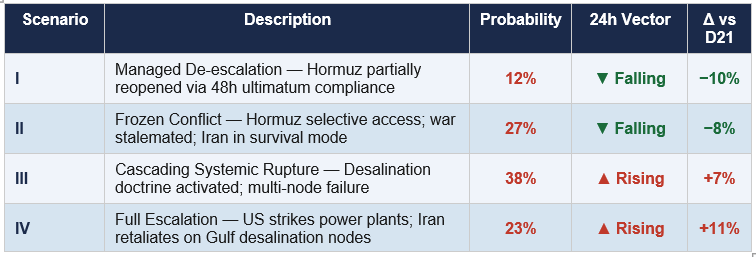
Trump’s 48-hour ultimatum demands that Iran open the Strait of Hormuz or face US strikes on Iranian power plants. It is the most consequential strategic decision of the conflict to date, and it is consequential precisely because of what it forces, regardless of which direction Iran moves.
If Iran complies: the IRGC accepts public humiliation under a 48-hour US ultimatum, legitimising coercive ultimatum diplomacy as a mechanism for extracting strategic concessions. The domestic political consequences for the IRGC’s authority are severe. Compliance probability, with the IRGC in operational command, is structurally low.
If Iran does not comply and the US strikes power plants: Iran retaliates against Gulf desalination infrastructure. The UAE, Bahrain, and Kuwait face water crises within days. Saudi Arabia faces political instability within weeks. The Gulf coalition states, which have already issued what Turkey’s Foreign Minister called last warnings to Iran, face a decision about their own military response.
The dual-track signal, in which Trump’s team is simultaneously game-planning for Iran peace talks per Axios, does not resolve this contradiction. It maps onto the same structural ambiguity that has characterised US strategy since Day 1: maximum pressure ultimatum running in parallel with back-channel peace architecture. The question is whether the 48-hour window allows sufficient time for back-channel progress to produce a face-saving Iranian exit. Given that Larijani, the last Iranian figure capable of managing a negotiated exit, was killed earlier in the conflict, the answer is probably not.
The 48-hour ultimatum is not a deadline for Iran. It is a decision point for the system. When it expires, the global economy will be operating under whichever scenario has been selected, by default if not by design.
IV. THE SIMULTANEITY PICTURE AT DAY 22
The energy-food-water triangle
Thirty-nine oil and gas facilities have been struck in the Gulf region. Each struck facility represents a node in the petrochemical supply chain that feeds nitrogen fertiliser production, which feeds agricultural yields, which feeds the food security of populations that the World Food Programme estimates could reach 45 million people in acute hunger by June. Iraq has declared force majeure on foreign-operated oilfields. Bangladesh has curtailed LNG imports, shutting fertiliser plants. The kharif planting season in South Asia begins in June. The fertiliser buffer in the most exposed economies is 30 to 60 days. We are on Day 22. The buffer is being consumed faster than diplomatic resolution can plausibly arrive.
Bloomberg’s “Fertiliser Shock Escalates” headline is the fourth systemic risk indicator crossing the triggered threshold. This is the cascade operating as a sequential system: energy disruption generates petrochemical supply disruption, which generates fertiliser price shock, which threatens agricultural output, which generates food insecurity, which generates social instability in exactly the countries, among them Sudan, Bangladesh, Pakistan, Nepal, and Sri Lanka, that have no fiscal cushion to absorb it. This sequence does not reverse when the shooting stops. The agricultural calendar does not wait for diplomatic resolution.
The Gulf coalition and its exposure
More than 20 nations have signalled readiness to contribute to Hormuz shipping security. Saudi Arabia has declared Iranian embassy staff persona non grata. MBS and al-Sisi have publicly warned that Iranian attacks threaten regional stability. Turkey’s Foreign Minister has confirmed that Gulf states have issued their last warnings to Iran. This hardening of the Gulf coalition is strategically significant and simultaneously exposes the coalition’s most acute vulnerability. Every Gulf state that enters formal confrontation with Iran places its own desalination infrastructure under the desalination doctrine’s targeting logic. The coalition is not gathering strength against a weakening Iran. It is gathering momentum toward a threshold event that would transform the conflict’s geographic and humanitarian scope in a single operational moment.
The Houthi dormancy and the Red Sea trap
The Houthis have stated explicitly that they will activate Red Sea operations when Iran’s Hormuz control is weakened by US escort convoys. Trump has committed to escort convoys. The first convoy attempt is the trigger. The simultaneous closure of Hormuz and the Bab el-Mandeb Strait, the world’s two most critical energy chokepoints (together with the Strait of Malacca), is the full cascade activation scenario. Both corridors closed simultaneously. The Cape of Good Hope detour adds 10 to 14 days to every voyage in global shipping, multiplying costs, insurance premiums, and fuel consumption across all global trade at once. Sri Lanka’s 2022 collapse, triggered by a fuel crisis far less severe than the current one, gives us the human-scale preview of this scenario multiplied across 15 or 20 equivalent economies simultaneously.
V. THE DRAGONBEAR AXIS: CONSOLIDATION UNDER COVER OF CRISIS
The DragonBear thesis, which identifies Russia and China as operating in strategic coordination across all systemically relevant domains without forming a formal alliance, has been validated by this conflict in ways that exceed even the analytical framework’s own predictions.
Consider what China has accomplished in 22 days without firing a single weapon, committing a single naval asset, or making a single statement that could be characterised as hostile to international norms. It is absorbing 1.1 to 1.5 million barrels per day of Iranian crude through teapot refineries in yuan-denominated transactions that directly challenge the petrodollar architecture. It is expanding the digital yuan network with 12 new banks, institutionalising alternative monetary infrastructure during the very crisis that created the demand for it. It has announced stunning critical minerals finds, the raw material dominance required for the next technological epoch, while the US deploys the USS Tripoli to the Gulf and creates a strategic opening in the Pacific. And it has rejected Hormuz Coalition membership while simultaneously not hindering Japan’s preferential Hormuz access through back-channels, performing access diplomacy on Iran’s behalf without appearing to do so.
This is not opportunism. It is architecture. The DragonBear axis has demonstrated that it can support a US adversary sub-kinetically, including through BeiDou navigation, YLC-8B anti-stealth radar, and yuan settlement facilitation, without crossing the kinetic threshold that would trigger direct confrontation; benefit economically from the oil price surge; exploit the Ukraine negotiation freeze created by US attention diversion; and refuse coalition membership while positioning for maximum leverage in the post-conflict diplomatic reset.
Washington’s rejection of Russia’s offer, in which Moscow proposed to curb support for Iran in exchange for halted US aid to Ukraine, is the single most consequential strategic decision not yet fully analysed in the Western press. By rejecting this offer, Washington closed another available channel that could have directly exercised pressure on Iran at the cost of support for Ukraine.
On the Russia vector: Ukraine’s sudden offensive, with Starlink restored following Russia’s loss of access, represents the first tactical reversal for Moscow since the Iran war began. It does not alter the Cold War 2.0 architecture. But it confirms a core Simultaneity dynamic: Russia’s Iranian gambit consumed diplomatic bandwidth and drew US attention while Ukraine exploited the opening. The system’s multi-theatre simultaneity is now visible in both directions. The DragonBear axis emerges structurally intact. China notes the outcome. Its collective leverage is higher today than on Day 1.
VI. EUROPE: STRATEGIC IMPOTENCE, FISCAL EXPOSURE, AND A NEW THREAT GEOMETRY
The Diego Garcia strike’s geopolitical transmission to Europe was delivered by the Telegraph in a single clarifying sentence: London, Paris, and Berlin now lie within Tehran’s reach. This is the development that Europe’s strategic community had not modelled. The war was not supposed to be geographically proximate to European capitals. It was supposed to be a Gulf crisis with economic spillovers. The Iranian ballistic missile capability demonstrated against Diego Garcia changes the European threat calculus in ways that a summit communiqué cannot address.
Europe’s practical response has been: Europe’s emergency fiscal response to the energy cascade is already visible across the continent, and it tells a coherent story about a bloc that is managing symptoms in the absence of a collective strategy. Italy has introduced tax reductions alongside windfall profit levies on energy companies. Spain has launched a large emergency package combining tax cuts, subsidies, and rent controls, and has moved to structurally decouple gas and electricity pricing ahead of schedule. Portugal has approved a legal framework for electricity price caps during energy crises. Greece has imposed caps on fuel profit margins alongside consumer subsidies. Austria has cut fuel taxes and capped retailer profit margins. Slovakia has restricted fuel sales and introduced differentiated pricing to protect domestic supply, including higher prices for foreign buyers. Slovenia has cut excise duties on fuel directly. Croatia has capped motor fuel prices. Eight European countries, each acting unilaterally, each absorbing a portion of the cascade through national fiscal instruments, each drawing down the same limited public balance sheet headroom that was already under pressure before the war began. This is not a European energy policy. It is eight national emergency responses to a single systemic shock, and the cumulative fiscal cost of those responses, compounding across the EU simultaneously, is precisely the stagflation-lite dynamic that Australia’s treasurer has already named and that UK ministers are now privately warning about. The EU’s slow and steady gas stockpiling instruction, issued from Brussels while member state capitals scramble for emergency measures, captures the institutional gap in a single image.
This is not a failure of political will. It is a failure of institutional architecture. The EU was not built to make rapid collective decisions under military time pressure. The unanimity requirement, the institutional separation between foreign and security policy and fiscal policy, the absence of a genuine EU defence framework mechanism, and the member state divergence on Iran are not problems that can be resolved by a Brussels summit. They are structural features of the European project that the rupture is exposing in real time.
Rheinmetall’s CEO warning that global air defence stockpiles are dwindling due to the Iran war is the most operationally acute signal from the European side. Every missile fired in the Gulf is a missile not available for Ukraine’s eastern flank. The Iran theatre is consuming the munitions architecture that was supposed to underwrite European security. The simultaneity is not metaphorical. It is physical. The same stockpile is being depleted in two directions simultaneously.
This is the thesis that needs to be stated plainly. Stagflation, the simultaneous occurrence of supply-driven inflation and economic contraction, is the macro condition that central banks fear most, because their core instruments were built for a different problem. Raising interest rates suppresses demand-driven inflation. It does nothing to repair a physical supply shortage. It cannot reopen the Strait of Hormuz. It cannot rebuild the 39 struck oil and gas facilities. It cannot replant the kharif season in South Asia. Australia is already confronting what its own treasurer describes as a 1970s-style stagflation shock. UK ministers are warning privately that the Iran war risks jeopardising Britain’s fragile public finances. Jay Powell is defending Fed independence against Trump’s political pressure while simultaneously managing an energy-driven inflation cycle for which the Federal Reserve has no adequate tool.
The IMF, the World Bank, the ECB, and every other institutional pillar of the Western economic order are in the same position: equipped for the crises of the past, structurally exposed to the crisis of the present. A supply shock-induced systemic crisis of this scale and scope, cascading simultaneously across energy, food, water, finance, and trade networks, is not something that any central bank can resolve by adjusting the price of money. The cumulative fiscal cost of eight national emergency packages compounding across the EU simultaneously, on top of the monetary policy constraints facing the Fed, the ECB, and the Bank of England, is the western democratic system reaching the boundary of its institutional capacity. What lies beyond that boundary has no modern precedent.
VII. THE UPGRADE: FROM UNCHARTED WATERS TO GLOBAL SYSTEM RUPTURE
Last week I wrote that the Simultaneity Theory’s central contribution was the identification of why these cascades cannot be resolved by any single intervention, because the system’s loops are closed. I stand by that analysis. What I am adding today is the rupture qualifier: the loops are not merely closed. Under the Day 22 pressure configuration, they are tightening.
The military loop: escalation generates diplomatic vacuum, diplomatic vacuum generates more escalation. The elimination of Larijani narrowed the negotiating pathway. The 48-hour ultimatum narrows it further. The IRGC’s operational control of Iran means the actor most capable of executing the desalination and energy doctrine is the actor making the decisions.
The energy-economic loop: supply disruption generates price pressure, price pressure generates fiscal stress, fiscal stress constrains the government bandwidth needed to manage social consequences, social consequences in vulnerable states generate political instability, political instability generates further supply disruption through force majeure, strikes, and governance failure.
The cascade-proliferation loop: the conflict’s precedent, a pre-emptive military strike on a non-nuclear state engaged in diplomatic negotiations, has transmitted a message to every non-nuclear middle power with strategic ambitions. The non-proliferation regime has not merely been weakened. It has been de-legitimised as a guarantee of state survival. Saudi Arabia, South Korea, Turkey, and Poland are drawing their own conclusions. The nuclear proliferation cascade operates on a 12 to 24-month timeline. Its first consequences will arrive after the war ends. They will arrive regardless of how the war ends.
The master variable has not changed, but its urgency has
Time remains the master variable. Every analytical question about this conflict ultimately reduces to it. How long can the US-Israeli air campaign be sustained against a domestic political clock running faster than the IDF’s target list? How long can Iran’s IRGC governance hold under decapitation and bombardment? How long can the global economy absorb 8 mbpd of daily scarcity before the cascade reaches the point of irreversibility, the missed planting season, the sovereign default, the collapsed state?
The honest answer is that no actor currently knows. Washington does not know how long Tehran can hold. Tehran does not know whether the 48-hour ultimatum is a bluff. Beijing knows both, probably, and is in no hurry to share. The market knows only the price, not the duration. And the 45 million people the World Food Programme projects into acute hunger by June know none of this. They know only the gap between what they needed and what arrived.
But there is a fifth uncertainty that sits beneath all the others and shapes every calculation being made in every capital right now, and it is the one that no intelligence service can model with confidence: the tipping point for regime collapse inside Iran itself. The IRGC is running the country. Mojtaba Khamenei is alive but politically marginalised. The pragmatic institutional strand that Larijani represented has been physically eliminated. What remains is a hardline military command structure operating under existential pressure, with a weapons inventory that its own spokesperson claims has not yet deployed its most advanced tier, inside a governance system that is being decapitated from the outside while absorbing the compounding social pressures of bombardment, economic isolation, and internal legitimacy erosion from within. Regime collapse in that configuration does not follow a linear trajectory. It does not announce itself in advance. It arrives suddenly, through the accumulation of pressures that each appeared manageable in isolation until the moment they were not. And the critical analytical problem is that a collapsing Iranian regime is not a more manageable Iran. It is a less predictable one, with operational command potentially fragmenting across IRGC factions, with the desalination and energy doctrine residing in the hands of actors whose decision calculus becomes harder to read precisely as the external pressure intensifies. Washington is no longer certain it wants the regime to fall at this stage. And Beijing, which has invested heavily in Iran as a structural node in the DragonBear architecture, has the most to lose from an Iranian governance collapse that it cannot control from the outside. The tipping point for regime collapse is not a variable that resolves the crisis. It is the variable that could transform a managed rupture into an unmanageable one.
VIII. THE ONLY EXIT: A TRIUMVIRATE FRAMEWORK FOR PREVENTING THE ABYSS AMID NEW COLD WAR
Here is what I need to say clearly, because I have not seen it stated with sufficient directness anywhere in the current analytical literature.
The United States, China, and Russia are each winning in the short term. The US has demonstrably degraded Iran’s military infrastructure, eliminated its nuclear programme, and established a new precedent of deterrence in the region. Russia is extracting elevated energy revenues, geopolitical leverage on Ukraine, and a sanctions waiver. China is consolidating yuan settlement architecture, absorbing discounted Iranian crude, and widening its strategic position in the Pacific while the US is pinned in the Gulf. All three actors have short-term incentives that are being satisfied.
And all three are generating the conditions for a collapse that will devour those short-term gains.
Because what is accumulating in the background of each of those winning positions is the cascade: 8 mbpd of daily scarcity compounding into a fertiliser shock, a food security crisis across 15 to 20 vulnerable economies, a financial contagion running through sovereign debt and emerging market currencies, a desalination doctrine that threatens the civilisational baseline of the Arabian Peninsula, and a wave of political turmoil that will arrive on a 6 to 12-month lag and cannot be recalled once it begins. No actor wins in that world. Not even the actors who think they are winning now.
The short-term winning positions of all three great powers are being financed by drawing down the structural capital of the global system itself. When that capital is exhausted, the ledger does not distinguish between winners and losers. It simply closes.
This brings me to what the Simultaneity framework identifies as the only viable exit. It requires coordination between the two rival blocs within what I call the Triumvirate of Great Power Dynamics: the US-led bloc, the China-Russia-led bloc, and the space between them where the actual outcome will be determined.
The United States, as the custodian of Israel’s security, has the standing to declare victory. The military objectives of Operation Epic Fury, the degradation of Iran’s military capacity and the elimination of its nuclear programme, have been substantially achieved. A declared victory is not a concession. It is a strategic act that opens the space for the sequence that follows.
The China-Russia bloc, as the custodian of Iran’s survival, must accept a new equilibrium before it can pressure Tehran toward compliance. That equilibrium requires acknowledging that Iran’s continued existence as a state is not compatible with the continuation of the current operational posture, and that the bloc’s long-term strategic interests, including energy infrastructure, yuan settlement flows, and the petrodollar alternative architecture, are better served by a living, functioning Iran than by a martyred one. Only from that acknowledgement can the bloc credibly press Tehran toward the five steps that close the rupture:
One: Credible security guarantees for Iran. Not symbolic language. Structural guarantees, backed by the Triumvirate, that Operation Epic Fury does not resume, that regime change is not the continuation of the policy by other means, and that Iran’s post-war political sovereignty is internationally recognised.
Two: Immediate cessation of all war activities. All kinetic operations suspended simultaneously. Not sequenced. Not conditional on Hormuz opening first. Simultaneous. Because Iran will not open the Strait while it is being bombed, and the US will not stop bombing while the Strait is closed, and that circular logic is precisely the closed loop that the Triumvirate framework exists to break.
Three: Immediate opening of the Strait of Hormuz. Full resumption of transit for all vessels. Not selective access. Not the current doctrine of passage for friendly tankers only. Full opening, monitored by a neutral maritime authority, as the irreversible signal that the energy cascade has been interrupted.
Four: Immediate political agreement via Oman on neutral terrain. Oman was the functional channel before the war. The breakthrough that was “within reach” on 27 February, one day before the strikes began, did not evaporate. It was suspended. Oman’s mediating role, within a Triumvirate-endorsed framework, is the architecture through which a face-saving exit exists for all parties. It does not require either side to acknowledge defeat. It requires both sides to acknowledge the alternative.
Five: Immediate post-war reconstruction of energy infrastructure and commodity flows. Oil, gas, helium, fertilisers, and food commodities must flow again not just through open shipping lanes but through rebuilt production capacity. This is the stage that transforms a ceasefire into a stabilisation. The 39 struck oil and gas facilities do not rebuild themselves. The fertiliser plants that shut do not reopen without upstream gas. The reconstruction framework must be agreed as part of the political settlement, not deferred to a post-war conference that never convenes.
These five steps are not idealistic. They are the minimum operational sequence required to interrupt the cascade before it reaches the point of irreversibility. They are also the only framework in which all three members of the Triumvirate can claim a version of the outcome they need: the US claims the military victory it has earned; the China-Russia bloc claims the security guarantees for Iran it has promised; and Iran survives to negotiate its place in the post-war order.
The alternative is that the cascade continues. The 48-hour clock expires. A power plant is struck. A desalination plant is destroyed. The Houthis activate the Red Sea. A sovereign default cascades through South Asia. And the question shifts from how to prevent the rupture to what can be reconstructed from the wreckage of a global system that three great powers allowed to break because none of them was willing to accept that their short-term winning position was being purchased at the cost of the system that makes winning meaningful.
I can't say I enjoyed reading this article anymore than I have enjoyed the grim analyses of others like Doomberg. The potential for global human suffering and death as a consequence of misanthropic ideologies across the religious and political spectrum seems as high now as it was during the height of cold war 1 when I was a boy and hid under my desk during school drills while my father pored over plans for bomb shelters.
According to some analysts, Iran is facing severe water shortages (overdrawn aquifers, drying rivers, low reservoir storage) and the social and economic consequences including rural water shortages, food insecurity, and migration from rural to urban areas are all contributing to social unrest along with the current war. They probably wish they had a lot more desalinization capacity than the 3% they did install. As to taking out the water supply of surrounding wealthy countries that do depend on desalinization, it is fairly likely that the plant designers took into account the vulnerability of facilities to attack in an inherently unstable region. They probably built in structural and geographic redundancies and some amount of storage and these facilities are likely protected by countermeasures that could be augmented by allies. So the IRGC will have to consider the consequences of an attack that might only be partly successful against the resulting retaliation that would almost certainly target dams, distribution nodes and gas-fired pumping stations, worsening an already critical water and food security situation in their own country. But they might anyway, and then the retaliation could turn into a much broader rupture as the author put it. Is this point in the current conflict the black swan event? We could find out in 15 days or 15 minutes unless the detente the author suggests is reached. Glass half empty.
Grim read, but a realistic unfiltered assessment that should be widely circulated and broadcast.